
Creating an Acousmatic Game: Behind the Scenes of Fluctus Planetarium
How to transform a contemporary multimedia art installation into an interactive gaming experience? A look back at the genesis of a singular transmedia project, where gravitational physics and electroacoustic composition converge toward a new form of collaborative creation.
From a Multimedia Installation to an Interactive Game
Fluctus Planetarium was born in 2023 from an artistic collaboration between Louis Jeanne and myself. Conceived as an installation for 8 giant screens accompanied by a 5.1 electroacoustic device, the original work explores the encounter between abstract visual projections and spatialized musical compositions.
Like many contemporary art works, Fluctus Planetarium faces a recurring challenge: the difficulty of finding sponsors and venues capable of hosting such an ambitious setup. Six giant screens, a multichannel sound system, the necessary space… Logistical and financial constraints drastically limit the possibilities for exhibition.
It was from this frustration that the idea of an interactive transposition was born: what if we transformed this installation into an accessible game, allowing the public to discover and even extend our creative universe?
The Source Universe: Deconstructed Portraits and Musical Gravitation
Louis Jeanne’s Planets
The visual heart of Fluctus Planetarium lies in the 8 planets created by Louis Jeanne according to a fascinating artistic process. Starting from nominative portraits—identifiable and singular faces—the artist subjects them to a systematic deconstruction that transforms them into abstract, mysterious, almost organic textures.
These decomposed portraits then become the surfaces of spherical planets, creating a spatial universe where humanity persists as a trace, as textural memory applied to celestial bodies.
My Musical Contribution
Each planet possesses its own sonic identity: eight electroacoustic compositions that I developed in dialogue with Louis’s visual creations, developing acousmatic scores from his textures. The 5.1 spatialization of the original installation allows for sonic immersion where each world resonates in the listening space, creating a three-dimensional planetary symphony.
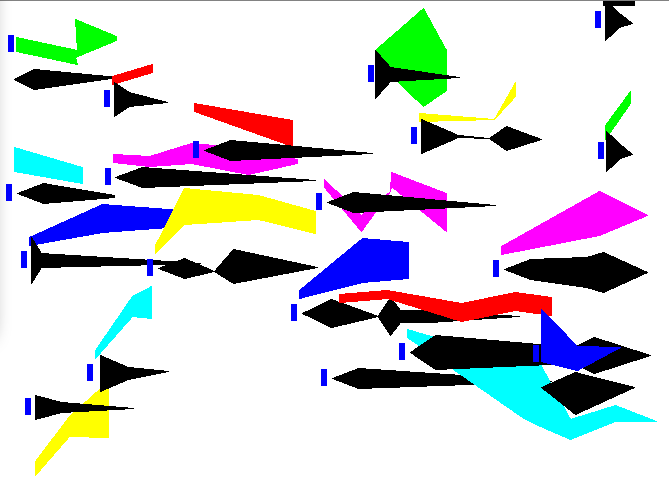 Original handwritten score of Fluctus Planetarium – Excerpt from electroacoustic compositions developed in dialogue with Louis Jeanne’s visual creations
This approach fits into my usual practice as an acousmatic composer, but with a new constraint: making sonic creation dialogue with an abstract visual universe, in a spatial and gravitational environment.
Game Mechanics: When Physics Becomes Gameplay
Gravitational Trajectories
The game principle of Fluctus Planetarium is directly inspired by celestial physics. The player launches meteorites into space, but unlike a classic action game, the trajectories don’t follow predictable straight lines.
Under the effect of planetary gravitation, these trajectories curve, deform, create ellipses. Sometimes meteorites enter transitory orbit around a world, sometimes they crash on its surface. This controlled unpredictability constitutes the heart of the gameplay: taming gravitational laws to achieve one’s objectives.
Musical Triggering by Proximity
The game’s major innovation lies in its reactive audio system. The closer a meteorite gets to a planet, the more audible the specific musical composition of that world becomes. The sonic space thus becomes an environment of musical exploration: navigating between planets means composing one’s own listening experience.
This mechanic transforms each game session into an improvised acousmatic performance, where the player’s choices determine the evolution of the sonic landscape.
The Creation Workshop: Democratizing the Artistic Process
The Collaborative 9th Planet
Beyond exploring the eight existing worlds, Fluctus Planetarium offers a revolutionary functionality: the creation workshop allows the player to build their own planet by following exactly the approach that Louis and I developed.
Complete Creative Pipeline
The creative process breaks down into precise steps:
- Import a portrait (landscape format required)
- Deconstruct the portrait to transform it into an abstract texture
- Apply the texture to a planetary sphere
- Physical parameterization: size, mass, gravitational field, rotation speed
- Sonification of the abstract texture into a raw sonic object
- Acousmatic retouching of the sonic object to create a coherent musical phrase
- Integration of the planet into the game universe and testing of interactions
This sequence reveals to the public the technical and artistic behind-the-scenes of our collaboration, transforming the player into a co-creator of the Fluctus Planetarium universe.
Innovation: Sonification as Creative Process
From Image to Sound
The most innovative aspect of the project lies in the sonification step: how to transform an abstract visual texture into sonic material? This question, central to our artistic research, becomes a creation tool accessible to the public.
The algorithmic process I developed analyzes the visual properties of the texture (contrasts, patterns, colors) to generate a corresponding sonic object. But this automatic transformation is only a starting point: the acousmatic retouching step then allows sculpting this raw object into a musical phrase coherent with the work’s aesthetic.
Interactive Acousmatic
Adapting my electroacoustic composition techniques to a gaming environment represented a considerable challenge. How to preserve the richness and subtlety of acousmatic listening in an interactive medium?
The solution lies in this hybridization: the game becomes a sonic exploration environment where each action triggers musical events, transforming gameplay into acousmatic performance.
Technical and Artistic Challenges
Preserving the Original Aesthetic
Transposing a multimedia installation into an interactive game poses complex aesthetic questions. How to preserve the visual impact of six giant screens in a domestic format? How to maintain the richness of 5.1 spatialization on standard audio systems?
These constraints led us toward creative solutions: optimizing the visual experience for different screen sizes, adapting spatialization for stereo, preserving the essence of the aesthetic experience while making it accessible.
Physical and Ludic Balancing
The realism of gravitational simulations constitutes another major challenge. Too simplified, trajectories lose their physical poetry. Too complex, they become unplayable. Balancing between scientific precision and gaming pleasure requires numerous adjustments and tests.
“Blind Play” Tests
Scheduled for early August, blind tests with new players constitute a crucial step. They will validate the accessibility of the creative process: can a user without artistic training really follow our approach and create their own musical planet?
I reassure you right away: everything has been designed so that the creation workshop tools are simple to use and perfectly ergonomic.
Perspectives: Democratizing Digital Art
Gaming as Cultural Mediation
Fluctus Planetarium represents an experimentation in the field of digital cultural mediation. By transforming a contemporary art installation into an accessible game, we explore new avenues for disseminating experimental works.
This approach responds to a major contemporary challenge: how to make accessible an art often perceived as elitist? Gaming, through its interactive and ludic dimension, opens unprecedented possibilities for artistic democratization.
Toward New Transmedia Forms
The Fluctus Planetarium experience fits into my broader transmedia approach, where literature (From Death to Life), electroacoustic composition (Hydrophonia) and ludic creation (Music & Me, Ascendance) converge toward a coherent creative ecosystem.
This approach allows exploring the same artistic universe from different angles, each medium revealing specific aspects of creation while nourishing the others.
Release and Perspectives
Fluctus Planetarium is currently entering its finalization phase, with a stable release planned for September 2025. Feedback from August tests will determine the final adjustments before making it available to the public.
Beyond simple entertainment, this project aims to propose a new form of artistic experience: a game that would also be a creation tool, an environment of aesthetic exploration, a space of collaboration between artists and audience.
Fluctus Planetarium thus questions the boundaries between creation and reception, between elitist art and accessible culture, between passive contemplation and active participation. A transmedia experience that transforms each player into a co-creator of the sonic and visual universe that Louis Jeanne and I have imagined.
The original Fluctus Planetarium installation (8 screens + 5.1) remains in search of sponsors and venues. Contacts for programming: ‘contact’ page
Follow the progress of Fluctus Planetarium development on jcploquin.itch.io