
HarpEK: The Continuous Gesture Instrument Reaches Maturity
After months of design, testing and adjustments, HarpEK reaches a decisive milestone: almost all critical hardware is validated and documented. The instrument takes shape, along with a renewed vision of gestural control in electronic music.
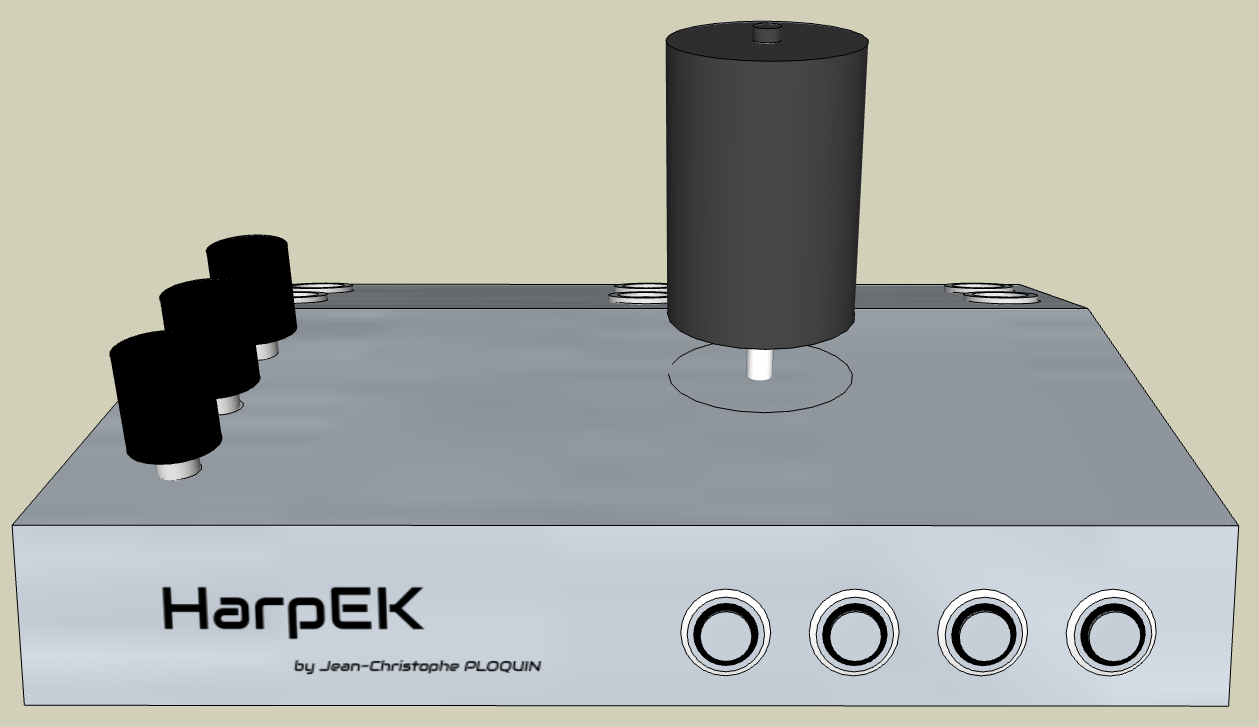 3D modeling of the HarpEK enclosure with ultrasonic sensors, encoders and joystick
🎛️ Validated Hardware Architecture
Platform and Power Supply
The system’s core relies on a fully operational ESP32-S3 DevKitC:
- Stable programming via Arduino IDE
- USB serial communication at 115200 bps
- Functional OSC-Serial protocol to Pure Data
The 5V / 3.3V power supply has been validated with precision:
- 5V 3A adapter
- AMS1117-3.3V regulator
- Measured voltages: 5.02V and 3.28V
- Clean common ground, no parasitic noise
Main switch, power terminal block, and Chenyang panel-mount USB-C connector have all been tested and validated both mechanically and electrically.
🎵 Sensors and Controllers: The Body at the Center of Play
Ultrasonic Harp (3 × HC-SR04)
HarpEK’s flagship feature: three ultrasonic sensors spaced 80 mm apart create a continuous gestural detection zone.
Measured Performance:
- Stable Winner-Takes-All algorithm
- 99% correct detections
- Latency ≈ 60 ms
- Useful range: 5–177 cm
- Distance → pitch mapping already musically exploitable
Each sensor has its dedicated LED (GPIO 45/46/47) for immediate visual feedback.
Expression Pedals (4 × Roland DP-10)
TRS pinout and 5V power supply measured with precision. Voltage dividers 1kΩ / 2kΩ convert 0–5V signals to usable ADC range (≈0–3.3V), yielding 0–2800 in 12-bit resolution.
No crosstalk between the 4 pedals: each channel remains clean and stable.
Rotary Encoders (3 × KY-040)
Tested simultaneously in circular mode 0–127 with wrap-around. Integrated buttons (SW) are reliable, no bounce or crosstalk issues.
Arcade Joystick (D400X-R4)
Functional version validated: 3 analog axes (0–4095) + center button. Integration via dividers identical to pedals.
🧠 Memory Interface and Feedback
Memory System (4 Gebildet 12mm Buttons)
Eurocard wiring completed and tested. Logic scheme separating buttons and LEDs, firmware management planned with exclusive selection of one active memory at a time.
Each memory will be able to store a complete configuration of mappings, scales, or Pure Data presets.
🔧 Electronic and Mechanical Architecture
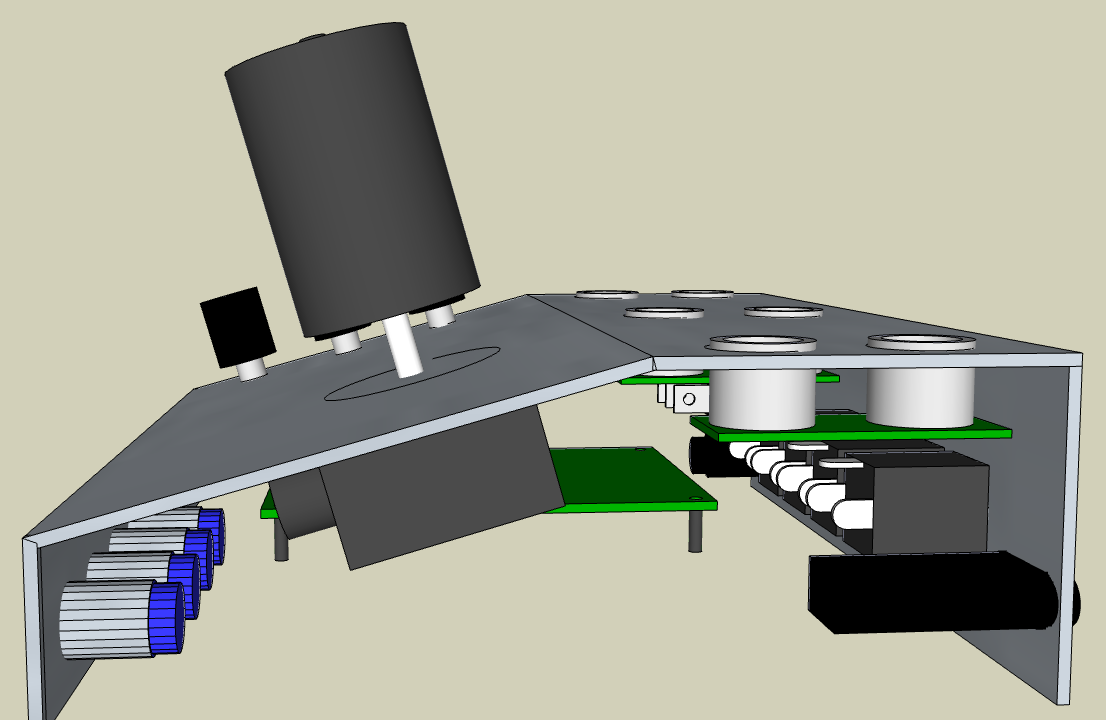 Exploded view: Eurocard, ESP32, connectors and internal wiring
Eurocard 100×80 mm
Main board completed with professional quality:
- ESP32 headers soldered
- Power terminal block fixed
- Voltage dividers installed
- Magnifying glass inspection: continuities verified, no short circuits
Complete Connection Table
85 GPIO connections documented in a LibreOffice spreadsheet. Each signal, ground, and power supply has been cross-verified. No remaining inconsistencies.
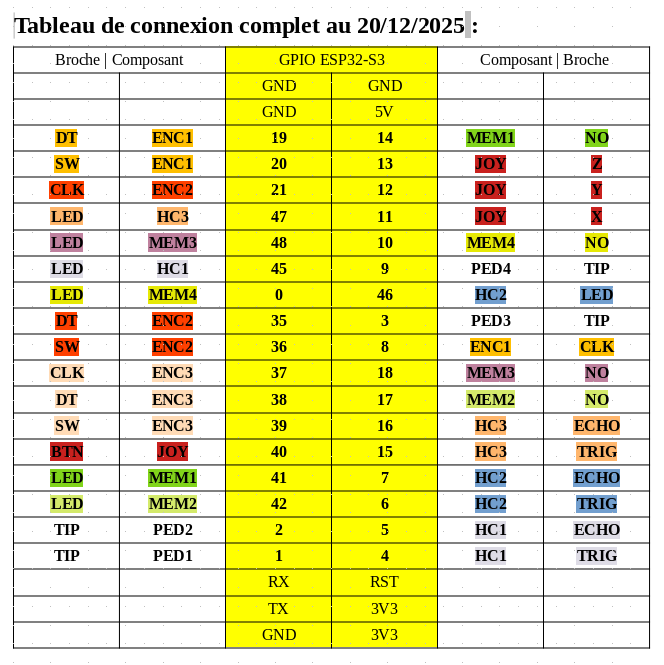 Comprehensive table of 85 ESP32-S3 GPIO connections
Hammond 1455N1602 Enclosure
Complete 3D modeling in SketchUp. A4 templates for all 4 faces validated:
- Flush HC-SR04 sensors (front face)
- Encoders, joystick, memory buttons (top face)
- TRS pedal jacks, USB-C, power switch (rear face)
- Internal clearances verified: no mechanical conflicts
💡 Instrumental Philosophy: Continuous Gesture
HarpEK is not a simple MIDI controller. It’s an instrument designed for continuous gesture, a response to the limitations of traditional protocols.
Beyond MIDI
The OSC-like protocol over USB serial allows exploitation of the full 12-bit resolution of sensors, without the 7-bit MIDI constraint. The instrument’s language becomes a personal alphabet, mapped in Pure Data to:
- Microtonal scales
- Spectral spaces
- Non-metric rhythmic structures
- 5.1 and 8.1 spatialization
A 1980s Heritage
HarpEK draws inspiration from analog joysticks and modular synthesis: the musician shapes continuous flows rather than stacking isolated notes. With the ultrasonic harp, pedals, joystick, and encoders, the body becomes central again: every hand or foot movement becomes a sonic trajectory.
Instrumental Immediacy
The goal: for the musician to think in gesture and timbre, not in “parameters” or “messages”. HarpEK extends an instrumental tradition into 2025 computer music.
🚀 Next Steps
With all major technical building blocks validated, the upcoming phases are:
- Final assembly in the Hammond enclosure
- Complete calibration of sensors in real-world situations
- Firmware development: memory management and latency optimization
- Dedicated Pure Data patches for initial musical testing
- User documentation and first test concerts
HarpEK approaches its final form. The instrument is almost ready to play.
🎸 Open hardware project — Designed and documented for the experimental music community.